The author
Joseph Hill
A believer. A husband, father, grandfather, and son. A builder of companies, an inventor, a mentor, and for nearly a decade a deliverance minister. A man who spent fifteen years chasing a question he could not shake — and who wants what he found in the hands of every Christian willing to test it. He lives in McCall, Idaho with his wife Kelly and their dogs.

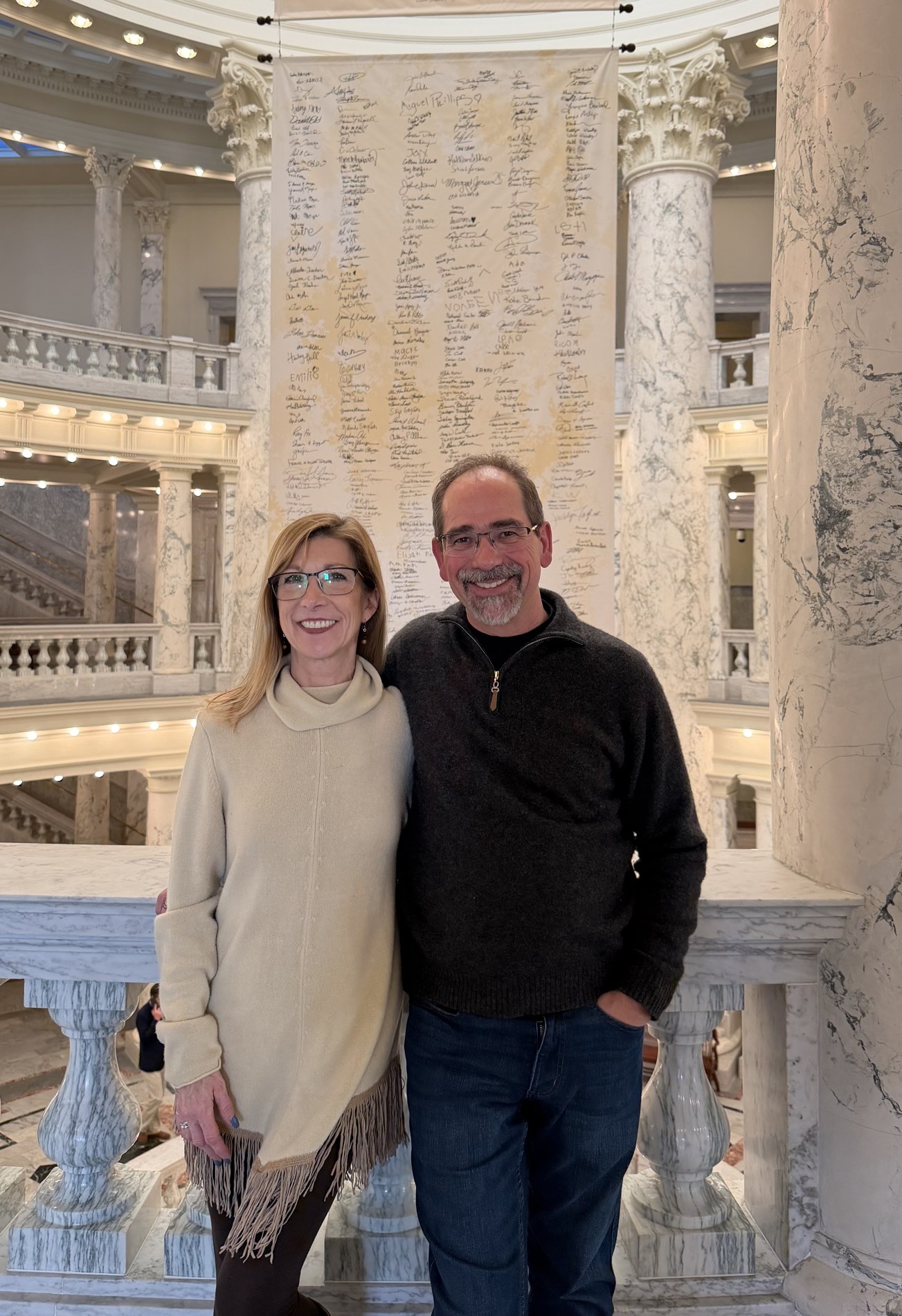
About the author
“I am not a professional theologian, nor do I claim any special authority beyond that which belongs to every believer who diligently studies the Scriptures.” That sentence, from the preface, is the posture of the whole book.
Joseph Hill is a businessman, researcher, and lifelong student of Scripture who spent more than fifteen years building the case presented in this book. He did not set out to write a theological treatise. He set out to answer a question that had been quietly nagging him for decades: what if the prophecies actually meant what they said, to the people they were said to?
That question led him into the original Greek and Hebrew texts, into the writings of Josephus and Tacitus and Eusebius, into the Dead Sea Scrolls reading of Deuteronomy 32, into the work of Michael Heiser on the divine council, and into a fifteen-year investigation that touched every major eschatological framework the church has produced. He followed the evidence the way an attorney builds a case: one data point at a time, brick by brick, until the weight of the accumulated evidence spoke for itself.
Joseph lives in McCall, Idaho, a small mountain town on the shores of Payette Lake. For over two decades, he has owned and operated a property management company serving the vacation rental and long-term rental markets across the McCall, Donnelly, Tamarack, and Cascade region. He built a business with a staff of roughly forty-five people, managed the complexities of two distinct operational divisions, navigated franchise agreements and legal disputes, and learned in the process what it means to be responsible for the livelihoods of others. He is also the creator of The No Spill Spout, a consumer product that reflects his instinct for solving practical problems with simple, well-designed solutions.
But if you asked Joseph what has consumed the deepest hours of his life, the answer would not be business. It would be this book.
The research behind Unraveling the Truth was not conducted in an academic library, though the sources are academic in their rigor. It was conducted in the early mornings and late evenings of a working life, by a man who believes the Berean model is not a suggestion but a mandate: examine the Scriptures daily to see if these things are so. Joseph's theological education is self-directed, built on primary sources rather than seminary curricula, and tested not by professors but by the most adversarial critics he could find. He sought out scholars, theologians, and artificial intelligence systems and asked them not to validate his conclusions but to dismantle them. He subjected his manuscript to seven formal evaluation passes covering factual accuracy, logic, sourcing, structure, tone, legal risk, and a steelman verdict. He generated simulated academic response letters and used them to stress-test every claim in the book before a single reader ever saw it.
Joseph writes with the warmth of a pastor, the precision of a prosecutor, and the patience of a teacher who knows the evidence will do the convincing if he lays it out methodically.
He does not lecture. He walks the reader through the evidence and lets the weight of the argument land on its own. His governing conviction is simple: "We are like attorneys, finding evidence to support our claims. We have to be 100%, or as close to it as possible." He holds himself to that standard because his name is on this book, and because the questions it addresses are too important to handle carelessly.
His approach to Scripture is rooted in what he calls the First-Century Lens: what would the original audience have understood? The men and women who first heard the words of Jesus and the apostles had no chapter and verse divisions, no systematic theology textbooks, and no twenty-first-century theological assumptions. What they did have was the Old Testament prophetic tradition, a working knowledge of apocalyptic genre conventions, and the immediate historical reality of Roman occupation and a corrupt religious establishment. Joseph reads the text through their eyes, not ours, and lets the original context govern the meaning before inherited tradition gets a vote.
He is not a credentialed academic, and he does not pretend to be. He is a Berean. He is a man who opened the concordance, pulled every definition for the Greek word in question, and asked whether the translator's choice narrowed the meaning in a way that served a doctrinal position rather than the text. He is a man who traced doctrines back to their human origins and asked, "Who decided this, and when? And why did no one see it for the first three centuries?" He is a man who believes that if "soon" does not mean soon, words have no stable meaning, and that if the Bible's own time indicators cannot be trusted to mean what they say, no claim built on that Bible can be trusted either.
Joseph is also a man of faith, not merely of argument. His interest in deliverance ministry and the reality of spiritual warfare is not theoretical. He believes the divine council described in Psalm 82 and the rebel structure of Ephesians 6:12 are as real as the mountains outside his window in McCall. The kingdom is not coming. It is here. And the believers who inhabit it have been given authority they have largely forgotten how to exercise, in part because centuries of misdirected theology told them to wait for something that already happened.
He lives in McCall with his wife, who serves as CEO of the family business and as a real estate agent specializing in lakefront and luxury properties on Payette Lake.
Joseph's transparency about his research process, including his use of artificial intelligence as a research tool, is deliberate. He believes honest scholarship declares its methods. He used AI systems not to write this book for him, but the way a prosecutor uses a research clerk: to surface evidence, to stress-test arguments, to find the strongest possible counterarguments before the opposition does. Every conclusion in this book is his. Every position was tested against the best objections available. And every claim is historically verifiable, because Joseph Hill does not ask his readers to take his word for it. He asks them to check.
"Nice and easy, Cowboy. Let the evidence do the talking."

McCall, Idaho
Light on the high country
He lives here with Kelly — “the love of my life. My biggest critic and most ardent supporter” — and their dogs, where the mountains still teach the same lesson as John 1: the darkness does not get the last word.
Acknowledgments
The people who sharpened the sword
- Kelly. Biggest critic, most ardent supporter.
- Erik Joseph Larson. “Thank you, my friend, for helping me sharpen my sword.”
- Melissa Radford. First person he could trust to read the draft objectively.
- Joe Eisenbrandt. Pastor at Mountain Life, who read the first two chapters when encouragement was the thing required.
- The Westwood V.P.P. Vision. Purpose. Plan.
- Erin. A visiting cousin’s girlfriend from Kentucky who handed him the phrase that refined his Core DNA: “Cycles of Completion.” Don’t start another task till this one’s done.
The posture
Test everything
He offers the book not as the final word, but as an invitation to read the Bible again with fresh eyes. The Bible alone is the infallible and final authority. His interpretations remain the work of a fallible human being. He urges every reader to examine what is written in the light of Scripture, testing all things and holding fast to that which is good.
And to the AI research partner who helped organize fifteen years of notes: “Thank you, Kid. We did the work.”